
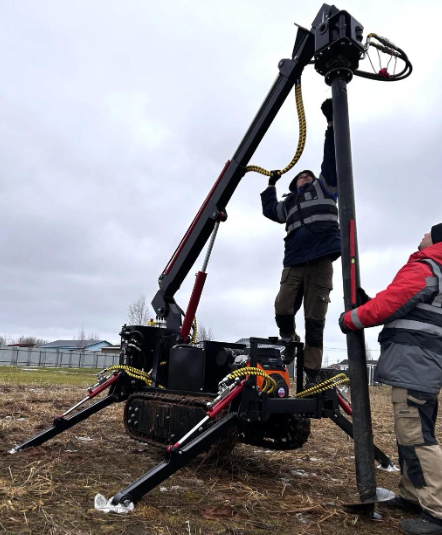
Earth screw anchors are used to secure structures where resistance to uplift, tension or other applied forces is required. Their applications include agricultural installations, temporary structures, retaining systems and certain renewable energy projects. The reliability of an anchoring system depends on its engineering design, the characteristics of the surrounding soil and the quality of installation. Selecting unsuitable machinery can compromise installation accuracy and introduce unnecessary expenses.
The installation process involves rotating an anchor into the ground until it reaches the position and depth specified by the designer. Although the principle appears straightforward, variations in soil density and underground obstructions can considerably affect the resistance encountered during penetration.
Equipment manufacturers offer several configurations to accommodate these differences. A suitable earth screw anchor driver from Iron Mechanics can be selected according to anchor dimensions, anticipated installation resistance and working conditions. Understanding these parameters helps contractors avoid purchasing machinery that is either insufficiently powerful or unnecessarily expensive for their assignments.
How ground conditions influence equipment selection
Soil rarely presents uniform resistance throughout the installation depth. An anchor may pass through relatively loose surface material before encountering compacted clay, dense sand or layers containing stones. These changes affect the rotational force required and may influence the stability of the installation equipment.
Ground investigations provide the information needed to anticipate potential difficulties. Where substantial underground obstructions are present, increasing the torque applied to an anchor may cause damage rather than resolve the problem. Alternative installation methods or revised anchor positions may be necessary, subject to engineering approval.
Contractors should also consider seasonal variations in ground conditions. Moisture content can influence soil behaviour, while frozen surface layers may complicate penetration. Equipment selected exclusively on the basis of favourable working conditions may struggle to maintain reliable performance throughout the year.
Understanding the characteristics of typical construction sites provides a more useful basis for machinery selection than relying on maximum power ratings alone.
Comparing different equipment configurations
Portable hydraulic drivers can be practical for smaller anchors and locations where vehicle access is restricted. Their relatively modest transport requirements make them suitable for contractors undertaking geographically dispersed assignments. However, the available torque, reaction arrangements and handling limitations must correspond to the specified anchor system.
Excavator-mounted hydraulic drives offer another option. They allow contractors to use existing construction machinery, potentially reducing investment costs. Compatibility between the attachment and the carrier’s hydraulic system is essential for reliable operation.
Self-propelled installation machines provide an independent platform designed for specialist installation work. Their mobility and integrated positioning systems can be advantageous on projects involving numerous anchors.
When comparing these equipment configurations, contractors should assess several technical and operational factors:
- Permitted installation torque for the specified anchor system.
- Hydraulic flow and pressure required by the drive unit.
- Compatibility with anchor shafts and connection adapters.
- Stability and management of reaction forces during installation.
- Accessibility, transport dimensions and equipment weight.
- Availability of maintenance services and replacement components.
The relative importance of these factors depends on the nature of the contractor’s workload. Equipment that performs efficiently on open agricultural land may prove impractical within a confined urban property.
Preventing installation errors and unnecessary wear
Incorrect machinery selection can create problems that extend beyond reduced productivity. A drive system delivering excessive torque may damage anchor components, particularly if the operator continues installation after encountering an obstruction. Conversely, insufficient available torque can prevent anchors from reaching their specified installation criteria.
Misalignment introduces additional difficulties. Anchors installed at unintended angles may require modifications to connection details or fail to perform as anticipated by the designer. Appropriate positioning equipment and regular alignment checks help reduce these risks.
Hydraulic compatibility also affects machinery durability. Operating a drive outside its specified pressure or flow range can increase heat generation and accelerate component wear. Contractors should verify the compatibility of all hydraulic components before putting a new equipment configuration into service.
Installation records provide a valuable reference when investigating performance problems. Documenting anchor positions, penetration depths and relevant torque measurements helps distinguish equipment limitations from unexpected ground conditions.
Equipment selection should ultimately reflect the engineering requirements of the anchoring system and the commercial realities of installation work. Contractors who evaluate complete operating conditions rather than isolated machinery specifications can reduce avoidable wear, improve installation consistency and maintain better control over project expenditure.