
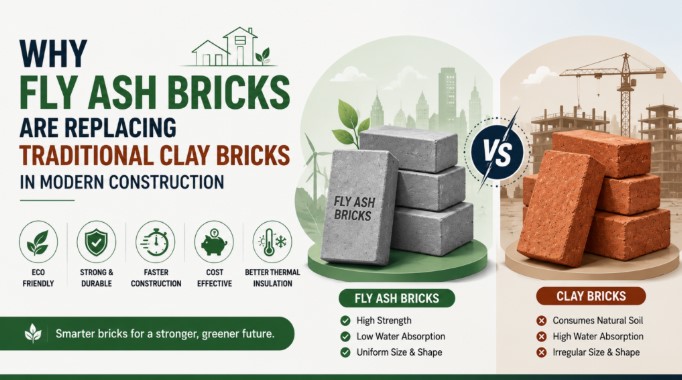
The construction industry is continuously evolving as builders, developers, and architects seek stronger, more sustainable, and cost-effective building materials. Among the many innovations shaping modern construction, fly ash bricks have emerged as a popular alternative to traditional clay bricks.
As environmental concerns, resource conservation, and construction efficiency become increasingly important, many construction professionals are evaluating building materials not only on cost but also on long-term performance. This shift has contributed to the growing adoption of fly ash bricks across residential, commercial, and industrial projects.
But what is driving this transition? Understanding the characteristics of both fly ash bricks and traditional clay bricks helps explain why many modern construction projects are moving toward fly ash-based alternatives.
What Are Fly Ash Bricks?
Fly ash bricks are manufactured using fly ash, cement, sand, and water. Fly ash is a by-product generated by thermal power plants and can be effectively recycled into construction materials.
Unlike conventional clay bricks, which require soil excavation and kiln firing, fly ash bricks are produced through a controlled manufacturing process that utilizes industrial by-products and consumes fewer natural resources.
Their consistent quality and performance have made them increasingly popular in modern construction applications.
Environmental Benefits
One of the primary reasons behind the growing adoption of fly ash bricks is their environmental impact.
Reduced Soil Degradation
Traditional clay brick manufacturing relies heavily on topsoil extraction. Over time, excessive soil excavation can contribute to land degradation and the loss of fertile agricultural land.
Fly ash bricks reduce dependence on natural soil resources and support more sustainable construction practices.
Effective Waste Utilization
Fly ash, which would otherwise require disposal, is effectively utilized in brick manufacturing.
This approach promotes resource efficiency and helps reduce industrial waste.
Lower Environmental Footprint
Compared to conventional kiln-fired bricks, fly ash brick production generally requires less energy-intensive processing, supporting environmentally responsible construction practices.
Superior Strength and Durability
Structural performance remains one of the most important considerations when selecting construction materials.
Fly ash bricks are known for their high compressive strength and durability.
Key advantages include:
- Better load-bearing capacity
- Improved structural stability
- Reduced breakage during transportation
- Longer service life
These characteristics make them suitable for a wide range of construction projects.
Better Dimensional Accuracy
One of the challenges associated with traditional clay bricks is variation in size and shape.
Fly ash bricks are manufactured under controlled conditions, resulting in:
- Uniform dimensions
- Smooth surfaces
- Consistent quality
This consistency helps improve construction accuracy and reduces material wastage.
Fly Ash Bricks vs Traditional Clay Bricks
Both fly ash bricks and clay bricks continue to be used in the construction industry. However, modern projects increasingly prioritize consistency, sustainability, and efficiency.
Strength
Fly ash bricks generally offer higher compressive strength, making them suitable for structures requiring enhanced durability and performance.
Water Absorption
Traditional clay bricks often absorb more water than fly ash bricks. Lower water absorption can help improve wall durability and reduce moisture-related concerns.
Dimensional Consistency
Fly ash bricks are manufactured using controlled processes, resulting in greater dimensional accuracy compared to conventional clay bricks.
Construction Efficiency
Due to their uniform size and shape, fly ash bricks can simplify masonry work and contribute to faster project execution.
Environmental Impact
While clay bricks depend on natural soil resources, fly ash bricks utilize industrial by-products, making them a more environmentally conscious option.
Reduced Mortar Consumption
The smooth finish and consistent dimensions of fly ash bricks often require less mortar during construction.
This can result in:
- Lower material consumption
- Faster masonry work
- Improved wall alignment
- Reduced overall construction costs
For large-scale projects, these savings can be significant.
Excellent Thermal Insulation
Energy-efficient buildings are becoming increasingly important in modern construction.
Fly ash bricks provide effective thermal insulation that can help:
- Maintain indoor comfort
- Reduce heat transfer
- Lower cooling requirements
- Improve energy efficiency
These benefits support sustainable building design and long-term operational savings.
Lower Water Absorption
Water absorption plays an important role in building durability.
Fly ash bricks typically exhibit lower water absorption rates, which can help:
- Reduce moisture penetration
- Improve wall strength
- Minimize cracking risks
- Enhance long-term performance
This makes them suitable for a variety of climatic conditions.
Faster Construction Process
Uniform dimensions and consistent quality can contribute to improved construction efficiency.
Builders often benefit from:
- Easier brick laying
- Improved workmanship
- Reduced labor time
- Faster project completion
These advantages are particularly valuable in projects with strict timelines.
Cost Efficiency
Although pricing may vary by region and supplier, fly ash bricks can contribute to cost savings through:
- Reduced mortar usage
- Lower plastering requirements
- Less material wastage
- Reduced breakage during handling
- Faster installation
Over the lifecycle of a project, these efficiencies can positively impact overall construction costs.
Growing Adoption in Modern Construction
Today, fly ash bricks are widely used in:
- Residential developments
- Commercial buildings
- Educational institutions
- Healthcare facilities
- Industrial projects
- Government infrastructure developments
Their combination of strength, sustainability, and construction efficiency aligns well with the requirements of modern building practices.
Conclusion
The increasing adoption of fly ash bricks reflects the construction industry’s growing emphasis on sustainability, efficiency, and long-term performance. While both clay bricks and fly ash bricks continue to serve important roles in construction, many builders and developers are choosing fly ash bricks for their strength, dimensional accuracy, lower environmental impact, and construction advantages.
As sustainable construction practices continue to gain momentum, fly ash bricks are expected to play an increasingly important role in shaping the future of modern infrastructure and building development.
Information Provided by Raj Mineral:
Choosing the right supplier is equally important. When you work with trusted suppliers like Raj Mineral, you’re not only investing in high-quality materials but also in a smoother, more efficient construction process.